Responsive CRM Workhold Management Website
Responsive CRM Workhold Management Website
NextTier | Executive Search CRM
project overview
project overview
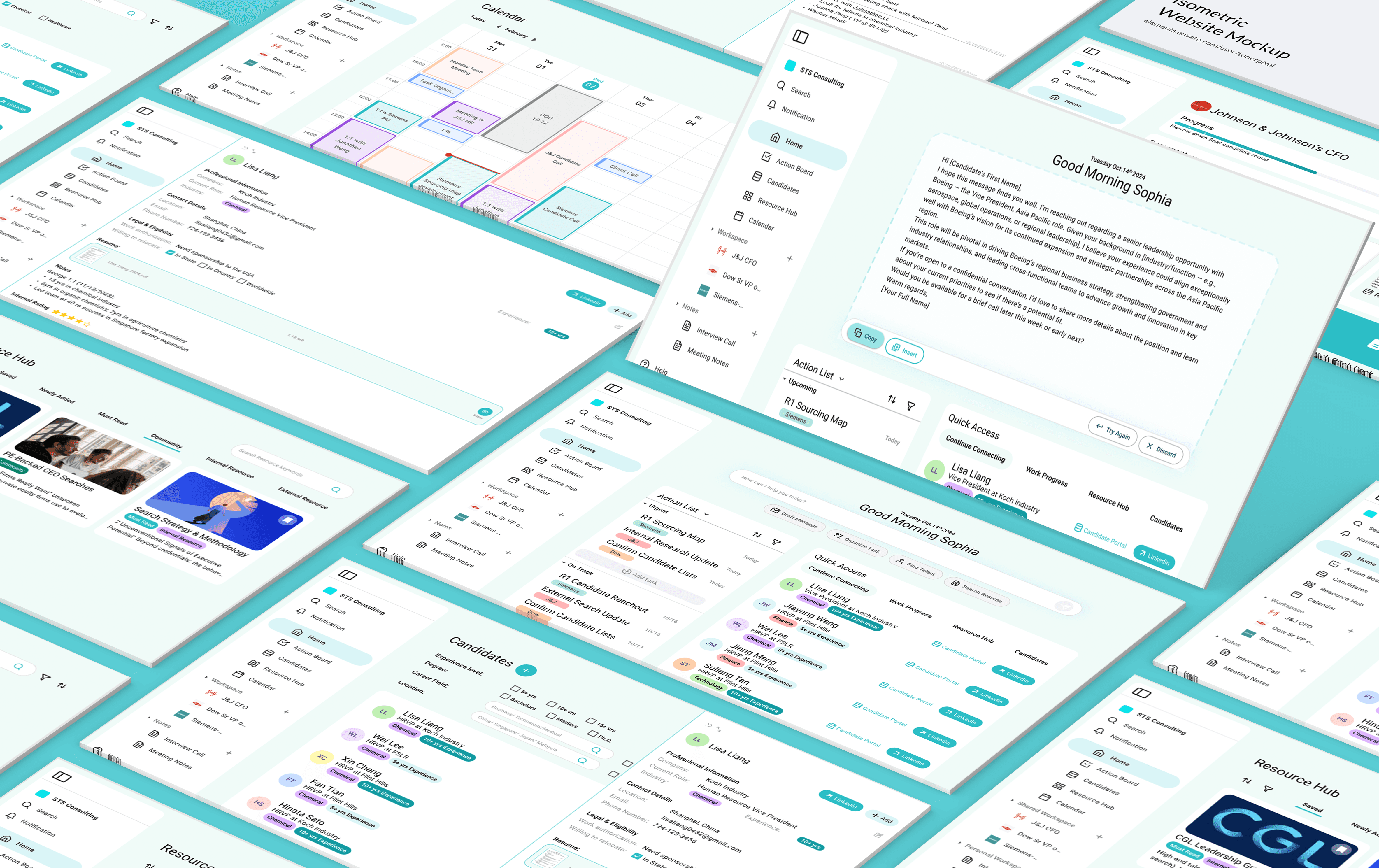
STS Consulting is a premium executive search firm dedicated to connect clients with best fit candidates. While interning at NextTier as the Product Design Intern, I designed an end-to-end responsive CRM website with human-centered design principles and ML-powered features. I built a scalable Figma design system encompassing components, typography, iconography, and grids, which improved engineering implementation accuracy by 24.1%. Through iterative design processes and leadership review sessions, I helped clarify MVP versus long-term strategies to accelerate decision-making, and defined and launched 3 MVP features that drove monetization and raised user acquisition.
Industry
Executive Search Firm
Time
Aug 2024 - May 2025
My Role
UX Designer
Tools
Figma
Google Doc
Skillset
Project Development
UI/ UX Design
User Research
Competitor Analysis
Impact
Impact
01
01
Designed a responsive CRM ( customer relationship management ) website with human-centered design and ML-powered features
Designed a responsive CRM ( customer relationship management ) website with human-centered design and ML-powered features
02
02
Built a scalable Figma design system (components, typography, iconography, grids), improving engineering implementation accuracy by 24.%.
Built a scalable Figma design system (components, typography, iconography, grids), improving engineering implementation accuracy by 24.%.
03
03
Iterated designs and led leadership review sessions, clarifying MVP vs. long-term strategies to accelerate decision-making.
Iterated designs and led leadership review sessions, clarifying MVP vs. long-term strategies to accelerate decision-making.
04
04
Defined and launched 3 MVP features (kanban, smarthub, candidate/workspace view) that contributed to acceleration of executive matches.
Defined and launched 3 MVP features (kanban, smarthub, candidate/workspace view) that contributed to acceleration of executive matches.
challenges
Challenges
The lack of centralized, synchronized CRM across fragmented communication channels.
The lack of centralized, synchronized CRM across fragmented communication channels.
Headhunters manage complex, multi-touch candidate relationships across disconnected platforms (WeChat, LinkedIn, CRM, Excel), leading to incomplete communication records, manual data synchronization, and collaboration blind spots that risk duplicate outreach and missed follow-ups.
Headhunters manage complex, multi-touch candidate relationships across disconnected platforms (WeChat, LinkedIn, CRM, Excel), leading to incomplete communication records, manual data synchronization, and collaboration blind spots that risk duplicate outreach and missed follow-ups.
Goal
Goal
Design a clear, efficient, and intelligent platform that helps headhunters quickly discover, organize, and match top candidates with the right opportunities.
Design a clear, efficient, and intelligent platform that helps headhunters quickly discover, organize, and match top candidates with the right opportunities.
Process
Process
Inspirational Search & Audits
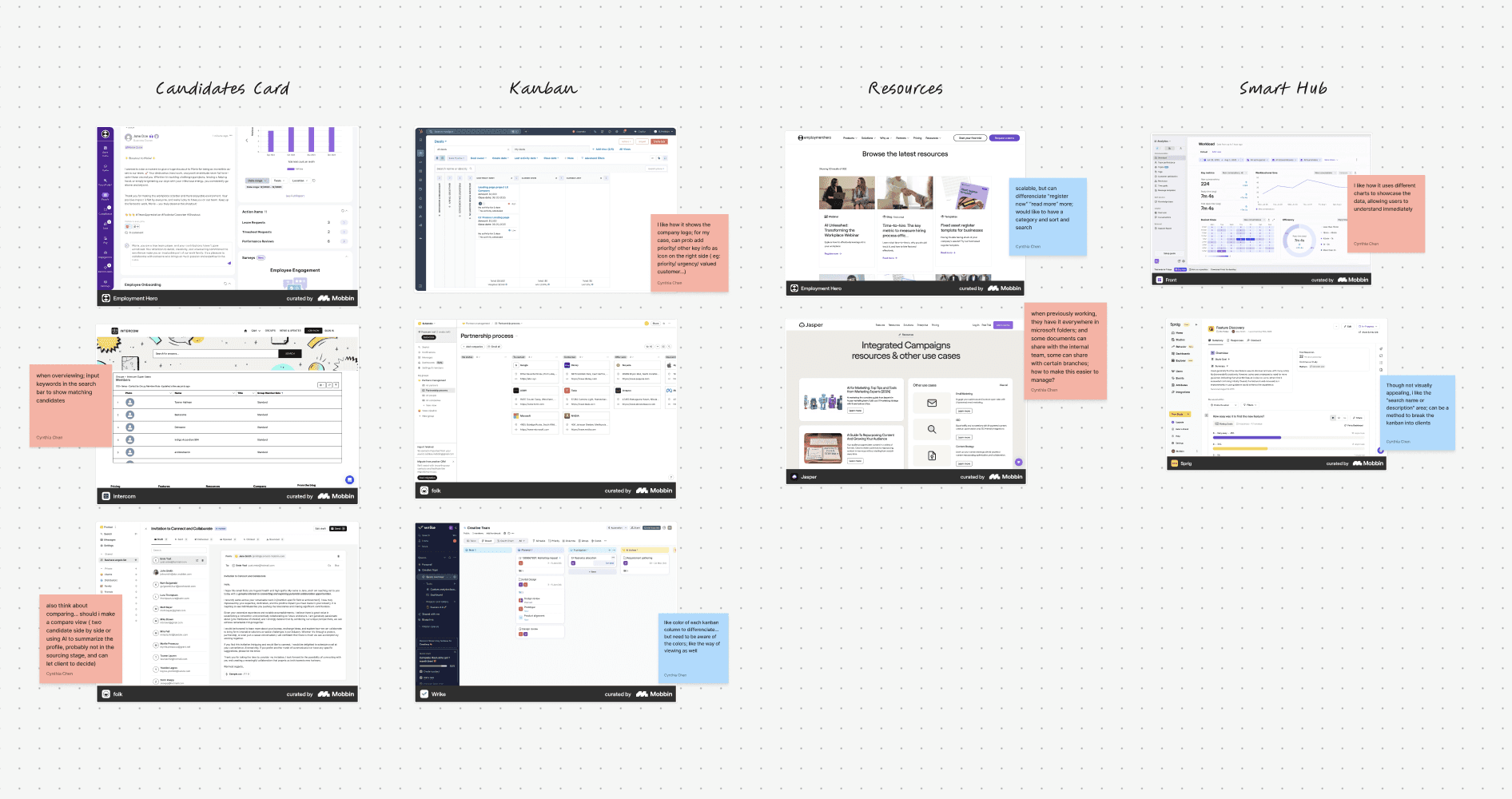
I conducted a comprehensive audit of the Smart Hub, AI-matching logic, and Project Kanban to identify gaps in task visibility and data accessibility.
Researched CRMs like Monday, Salesforce, Hubspot, Notion, etc and Work management like Asana, TheyDo, Sprig, etc.
I conducted a comprehensive audit of the Smart Hub, AI-matching logic, and Project Kanban to identify gaps in task visibility and data accessibility.
Researched CRMs like Monday, Salesforce, Hubspot, Notion, etc and Work management like Asana, TheyDo, Sprig, etc.
Takeaway
Takeaway
Modular flexibility enables recruiters to reduce friction and context-switching by tailoring their workspace through draggable modules and advanced filtering,
Intelligent acceleration allows for the replacement of repetitive manual entry with AI-driven profile summarization and proactive follow-up reminders to ensure no candidate relationship is lost.
User Interview
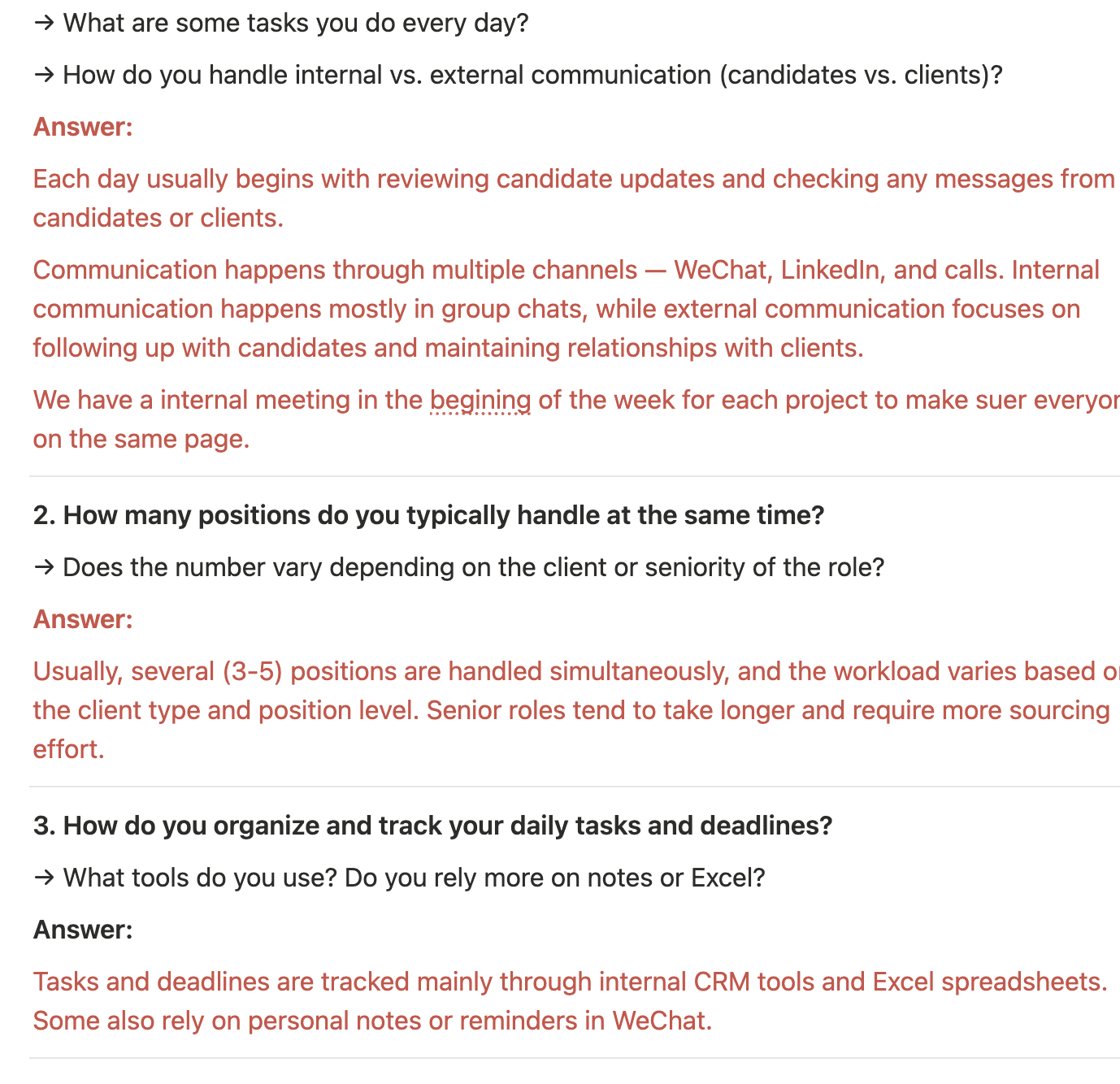
To better understand the pain points of users, I conducted a series of interviews with the internal executive search headhunters (6 individuals, 45 minutes each) to gain insight into the scope of the obstacles that they faced.
The interviews were structured around several key sections designed to provide a detailed understanding of users' experiences in the progress of finding the best fit candidate.
To better understand the pain points of users, I conducted a series of interviews with the internal executive search headhunters (6 individuals, 45 minutes each) to gain insight into the scope of the obstacles that they faced.
The interviews were structured around several key sections designed to provide a detailed understanding of users' experiences in the progress of finding the best fit candidate.
Interview Objectives
The real workflow and challenges of headhunters
How candidates and positions are managed internally
How communication flows within teams and with clients
What features they value most in an internal system
Interview Objectives
The real workflow and challenges of headhunters
How candidates and positions are managed internally
How communication flows within teams and with clients
What features they value most in an internal system
User Analysis & Pain Points
User Analysis & Pain Points
Primary
Primary
4 interviewees expressed their struggles when they forgot which channel they sent, searched, or added their sources.
Pain Points:
Too much manual entry + multiple storage locations → memory-dependent, inconsistent, error-prone.
Progress tracking becomes unreliable → duplicate contact, missed updates, confusion.
File management is messy; important documents are not centralized.
4 interviewees expressed their struggles when they forgot which channel they sent, searched, or added their sources.
Pain Points:
Too much manual entry + multiple storage locations → memory-dependent, inconsistent, error-prone.
Progress tracking becomes unreliable → duplicate contact, missed updates, confusion.
File management is messy; important documents are not centralized.
5 interviewees expressed their struggles when they forgot which channel they sent, searched, or added their sources.
Pain Points:
Too much manual entry + multiple storage locations → memory-dependent, inconsistent, error-prone.
Progress tracking becomes unreliable → duplicate contact, missed updates, confusion.
File management is messy; important documents are not centralized.
Secondary
Secondary
Sourcing are manual and time consuming, and often doesn't end up with a great result.
Pain points:
Repetitive outreach messages
No automation for follow-up reminders
Manual filtering, screening, and mapping. → overwork and inefficiency, but it stems from the fragmented system (primary problem).
Sourcing are manual and time consuming, and often doesn't end up with a great result.
Pain points:
Repetitive outreach messages
No automation for follow-up reminders
Manual filtering, screening, and mapping. → overwork and inefficiency, but it stems from the fragmented system (primary problem).
Research Synthesis
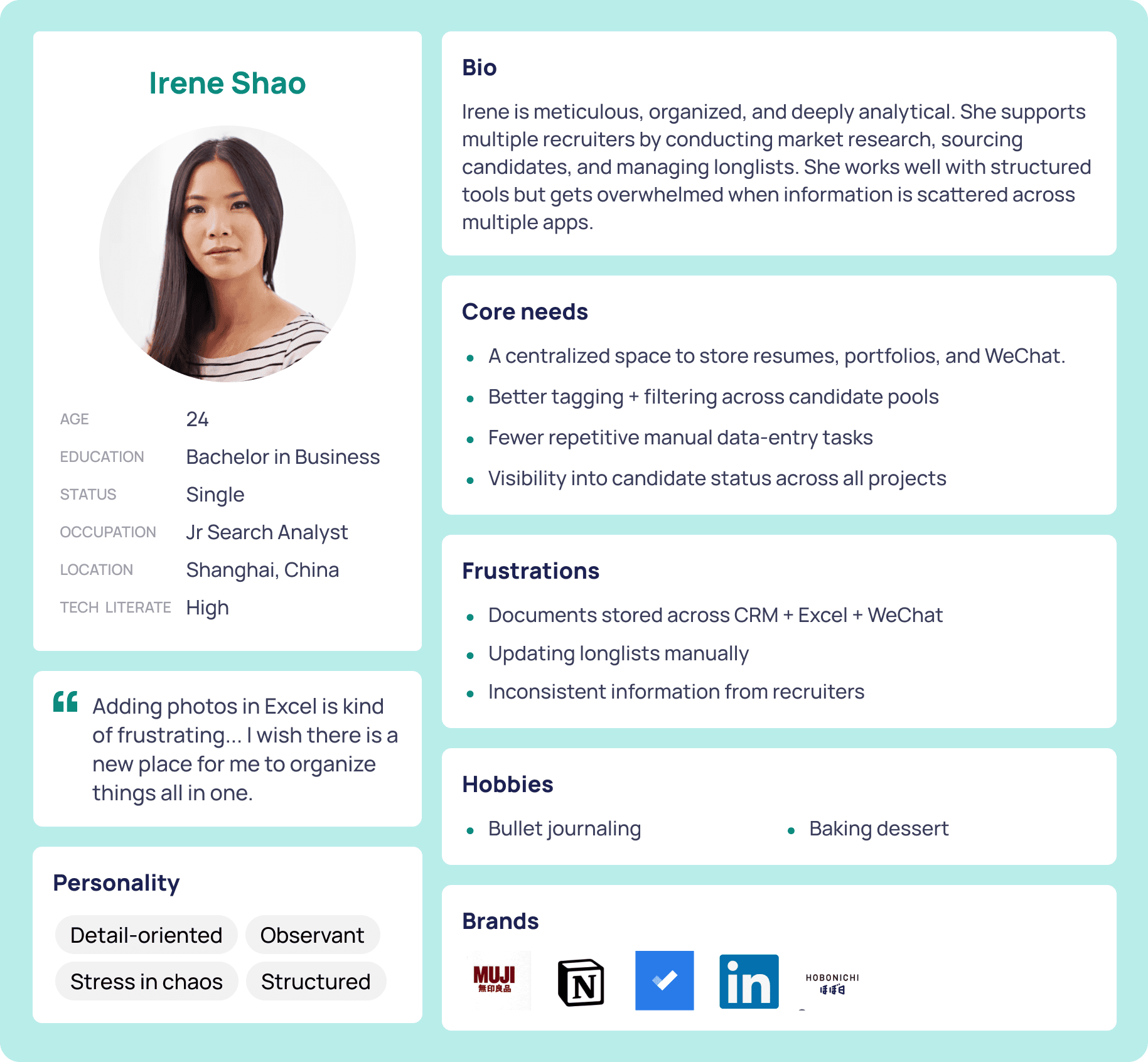
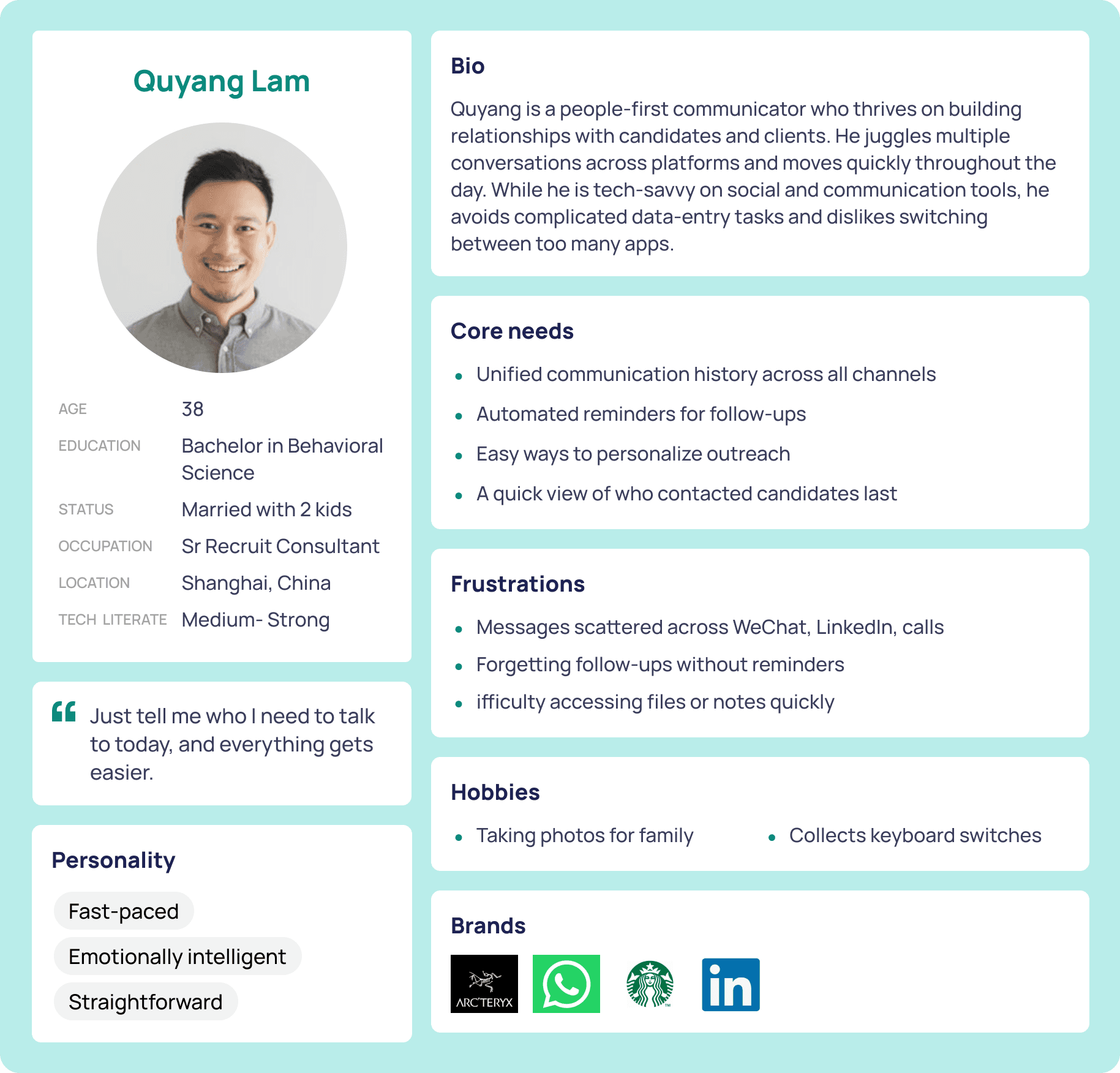
Based on the interviews and insights, I synthesized 2 representative personas to reflect the core users inside an executive search team: the Research Analyst and the Senior Recruiter. Their pain points reveal not only the operational friction caused by scattered communication tools and manual data entry, but also the deeper structural challenges of managing high-volume candidate pipelines with inconsistent systems.
Based on the interviews and insights, I synthesized 2 representative personas to reflect the core users inside an executive search team: the Research Analyst and the Senior Recruiter. Their pain points reveal not only the operational friction caused by scattered communication tools and manual data entry, but also the deeper structural challenges of managing high-volume candidate pipelines with inconsistent systems.
Users struggle with fragmented workflows across WeChat, LinkedIn, Excel, and CRM tools.
Tracking progress across multiple roles is difficult.
Juggling fast-paced sourcing and client expectations.
Fear of missing follow-ups, constant context switching, and frustration with messy information.
Users struggle with fragmented workflows across WeChat, LinkedIn, Excel, and CRM tools.
Tracking progress across multiple roles is difficult.
Juggling fast-paced sourcing and client expectations.
Fear of missing follow-ups, constant context switching, and frustration with messy information.
Brainstorming
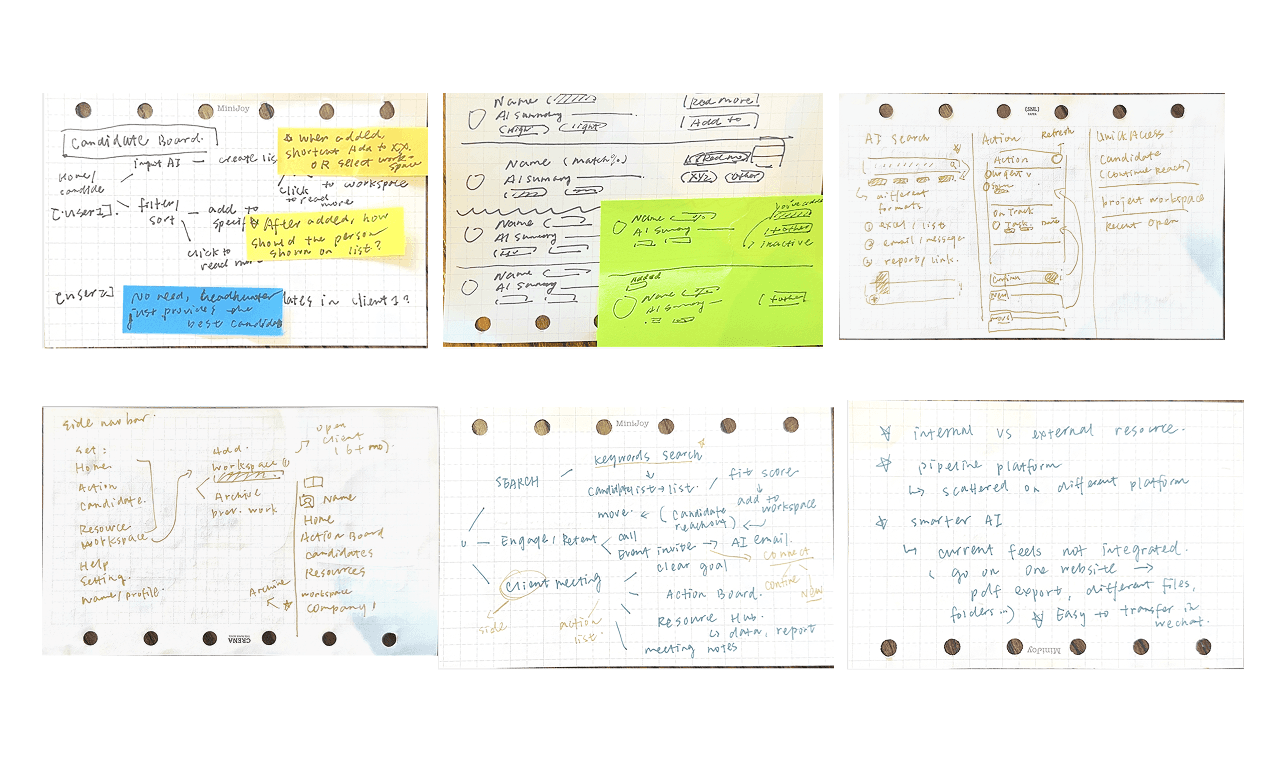
I started out with drawing some ideas down for the smarthub, kanban, and candidate views out based on the interviews and anaysis.
When meeting with the PM and the client team, they gave me extra feedbacks and emphasized on some key elements they want to include. ( See on the sticky notes)
I started out with drawing some ideas down for the smarthub, kanban, and candidate views out based on the interviews and anaysis.
When meeting with the PM and the client team, they gave me extra feedbacks and emphasized on some key elements they want to include. ( See on the sticky notes)
Objectives
Unify Fragmented Systems
Unify Fragmented Systems
Consolidate workflows from external apps into one centralized hub to eliminate manual entry and inconsistency.
Consolidate workflows from external apps into one centralized hub to eliminate manual entry and inconsistency.
Maximize Pipeline Visibility
Maximize Pipeline Visibility
Transform chaotic tracking into structured analysis for real-time updates on piepline and candidates.
Transform chaotic tracking into structured analysis for real-time updates on piepline and candidates.
Mitigate Task Fatigue
Mitigate Task Fatigue
Deploy intelligent reminders to manage client urgency and prevent critical candidate follow-ups from slipping.
Deploy intelligent reminders to manage client urgency and prevent critical candidate follow-ups from slipping.
By focusing on these objectives, I sought to create a more inclusive and comprehensible experience that supports the primary and secondary audiences through using one platform and complete different goals.
By focusing on these objectives, I sought to create a more inclusive and comprehensible experience that supports the primary and secondary audiences through using one platform and complete different goals.
Iterations
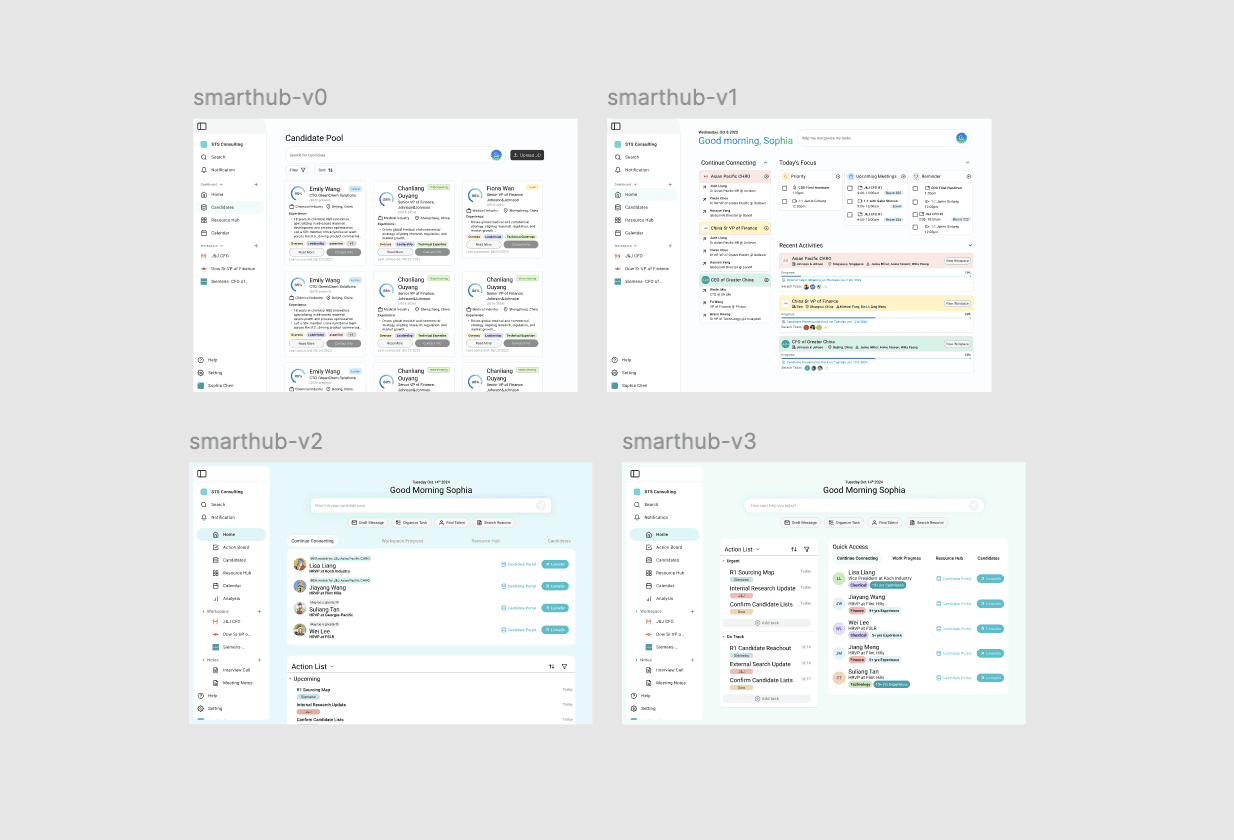
Throughout the process, I have monthly check-in with the client team and weekly check-in with my PM and engineering team to best understand the constraints and expectations one every screens.
Throughout the process, I have monthly check-in with the client team and weekly check-in with my PM and engineering team to best understand the constraints and expectations one every screens.
User Testings
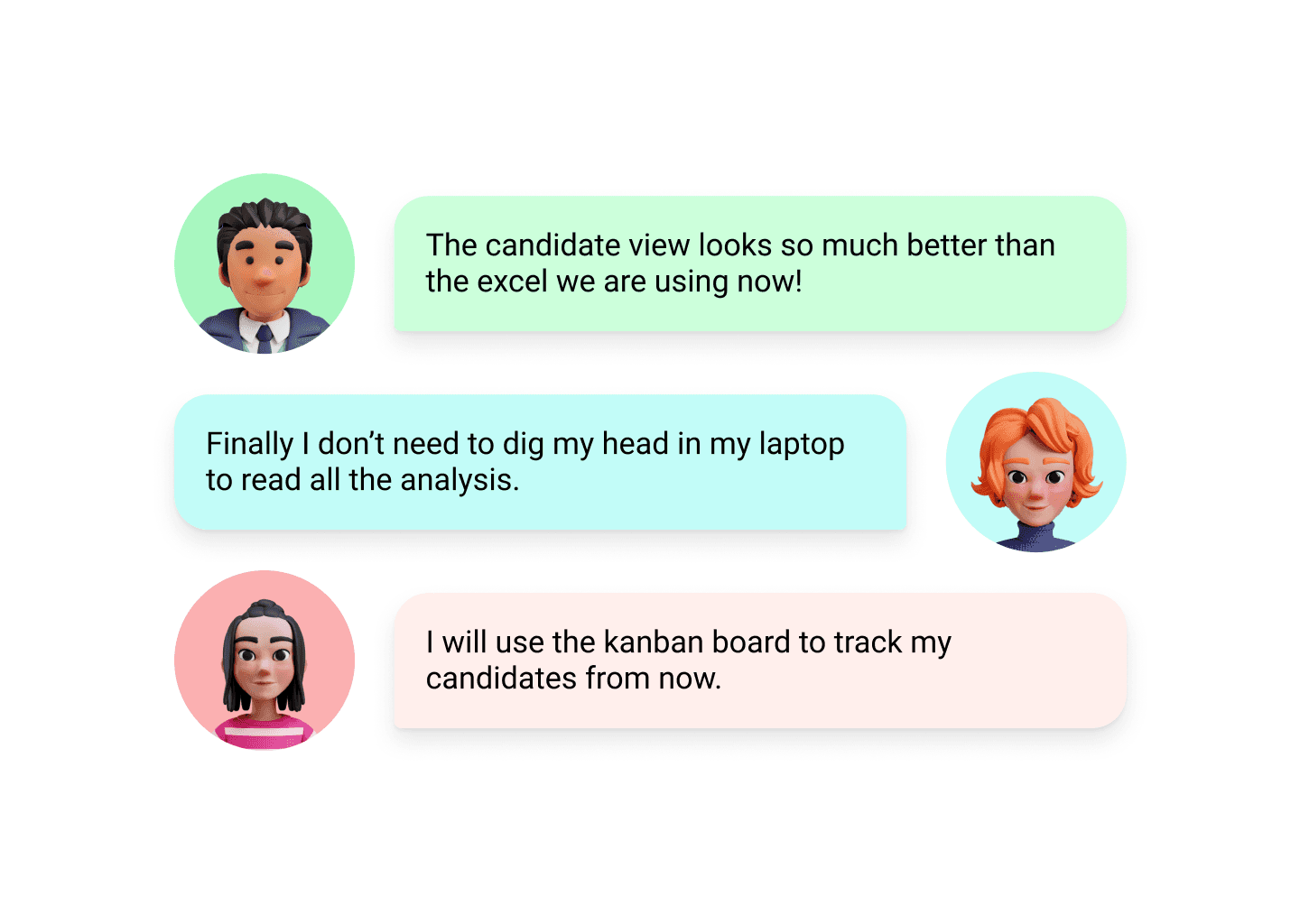
To validate the design, I conducted 4 user testing sessions with my previous interviewees. In the user testing sessions I showed them different design treatments, and asked their perceptions on the new design. These sessions validated many of my decisions, and based on their feedback, I iterated on the design to better serve users. And here are some of the quotes from them.
To validate the design, I conducted 4 user testing sessions with my previous interviewees. In the user testing sessions I showed them different design treatments, and asked their perceptions on the new design. These sessions validated many of my decisions, and based on their feedback, I iterated on the design to better serve users. And here are some of the quotes from them.
Final Design
Final Design
By balancing feedback from my PM and the client team, I revised the design with a focus on the productivity and analysis of clients.
By balancing feedback from my PM and the client team, I revised the design with a focus on the productivity and analysis of clients.

Generative-AI search
Generative-AI search
Unified interface to find candidates, summarize histories, and automate workflow.
Unified interface to find candidates, summarize histories, and automate workflow.
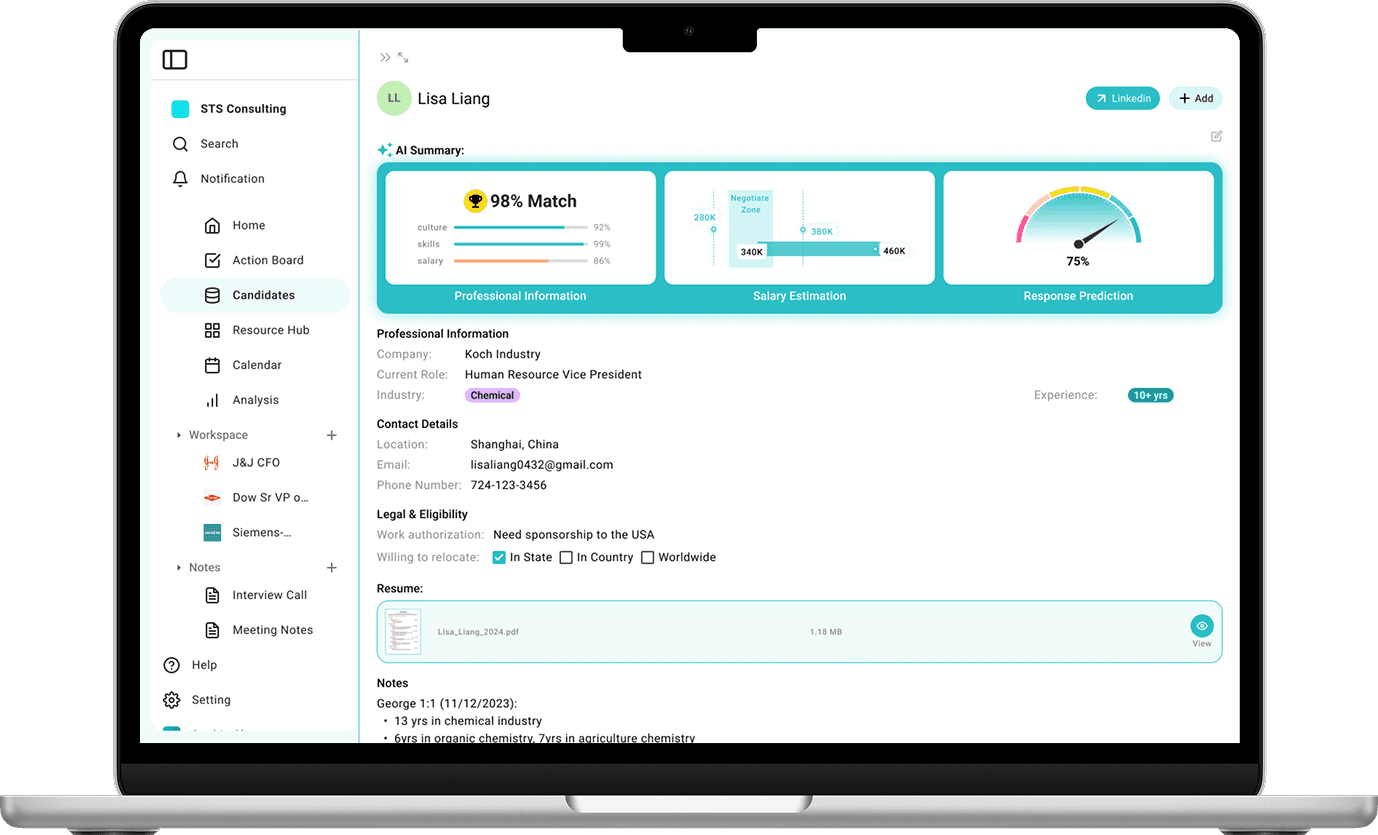
Candidate Viewpage
Candidate Viewpage
Utilizes AI-driven scoring to instantly evaluate professional fit, salary alignment, and response probability, providing headhunters with a data-rich summary that streamlines the qualification process.
Utilizes AI-driven scoring to instantly evaluate professional fit, salary alignment, and response probability, providing headhunters with a data-rich summary that streamlines the qualification process.
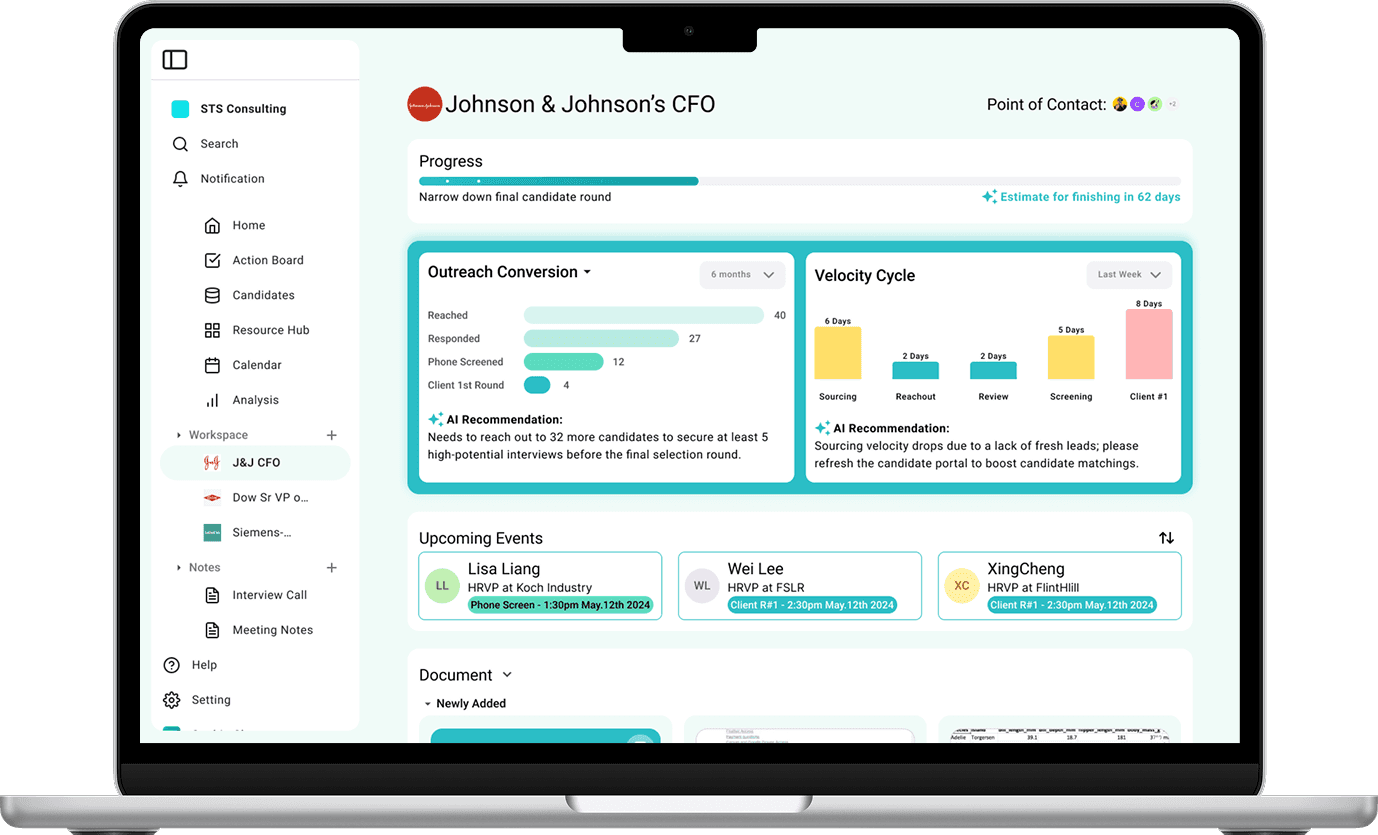
Workspace Analysis
Workspace Analysis
Centralized dashboard that tracks recruitment progress and outreach metrics while using AI to analyze pipeline velocity and recommend specific sourcing actions to meet hiring goals.

Pipeline Management
Pipeline Management
Track hiring stages via Kanban while AI monitors deadlines to prevent scheduling delays.
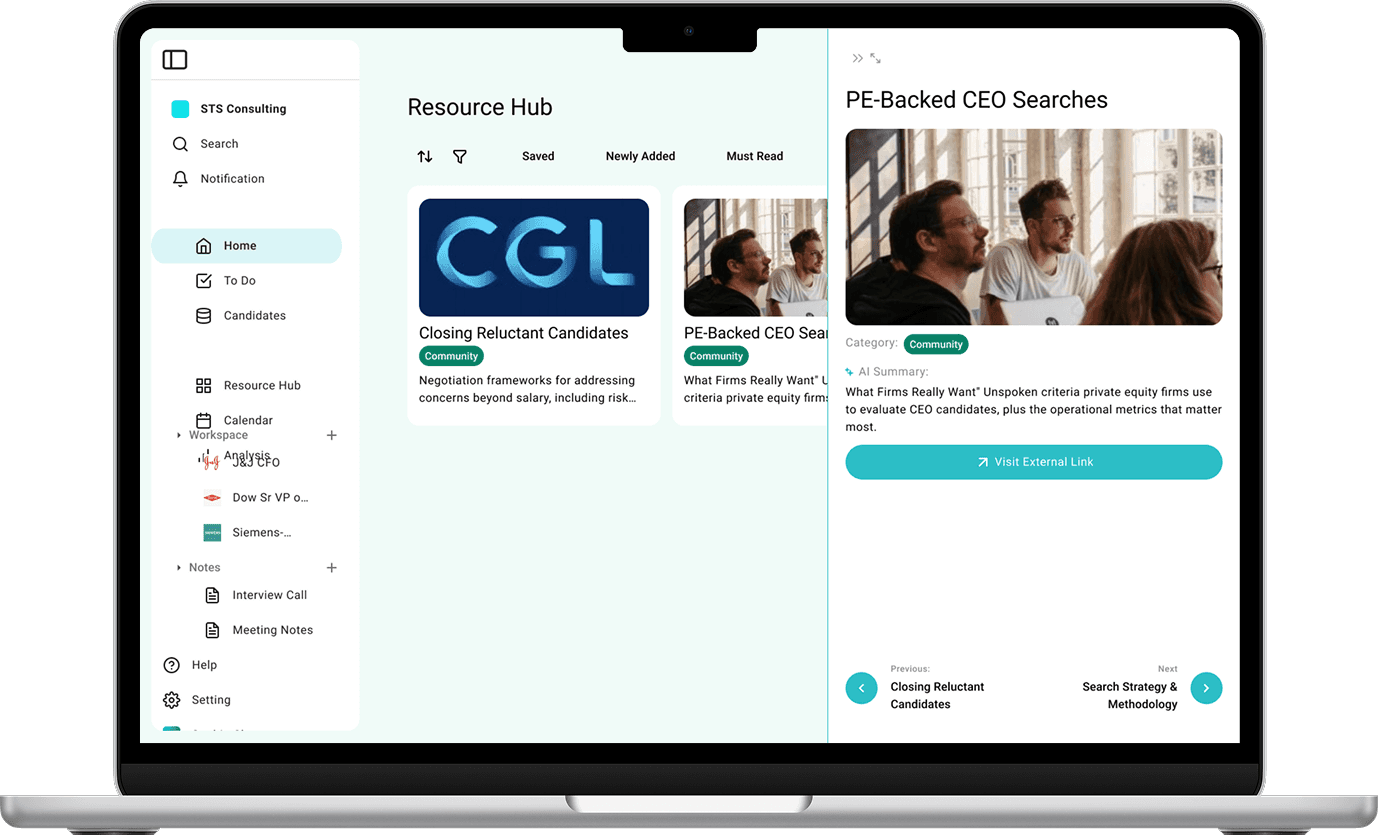
Resource Hub
Resource Hub
Consolidate critical links and platforms into a unified Resource Hub to streamline access and significantly reduce cognitive load
Reflection
Reflection
Architectural Scalability
Architectural Scalability
Effective headhunting requires balancing high-level pipeline oversight with granular candidate details. I prioritized a modular information architecture to maintain platform performance and clarity as recruitment volume scales. This design approach ensures that as the business grows, the system remains a robust, intuitive "Smart Hub" for managing complex workflows.
Effective headhunting requires balancing high-level pipeline oversight with granular candidate details. I prioritized a modular information architecture to maintain platform performance and clarity as recruitment volume scales. This design approach ensures that as the business grows, the system remains a robust, intuitive "Smart Hub" for managing complex workflows.
Cognitive Load Reduction
Cognitive Load Reduction
Working on a professional tool like NextTier challenged me to rethink the "simplicity" trope in UX. By designing for "flow state" rather than just "ease of use," I aimed to bridge the gap between complex functionality and effortless execution. This project solidified my belief that the best enterprise tools are the ones that disappear, allowing the user to focus entirely on their mission—connecting the right talent with the right opportunity.
Working on a professional tool like NextTier challenged me to rethink the "simplicity" trope in UX. By designing for "flow state" rather than just "ease of use," I aimed to bridge the gap between complex functionality and effortless execution. This project solidified my belief that the best enterprise tools are the ones that disappear, allowing the user to focus entirely on their mission—connecting the right talent with the right opportunity.
Fostering Collaboration & Leading Design Changes:
Fostering Collaboration & Leading Design Changes:
I practiced that design can lead a project and spark meaningful conversations across team collaborations. In this project, I worked with my PM, 2 front-end engineers tightly to ensure the handoff are clear and organized.
I practiced that design can lead a project and spark meaningful conversations across team collaborations. In this project, I worked with my PM, 2 front-end engineers tightly to ensure the handoff are clear and organized.
Being Aware of Edge Cases & Ugly Designs
Being Aware of Edge Cases & Ugly Designs
In executive search world, process can varies. Thus, edge cases and ugly designs happen often in certain circumstances. From usability testings and interviews, I was able to understand and adapt changes fast to ensure the designs are intuitive and functional in all cases.
In executive search world, process can varies. Thus, edge cases and ugly designs happen often in certain circumstances. From usability testings and interviews, I was able to understand and adapt changes fast to ensure the designs are intuitive and functional in all cases.